Everything I've built, one episode at a time
Each episode is one real thing I built with Claude Code — shown end to end, with the exact prompts and the free code to run it yourself.
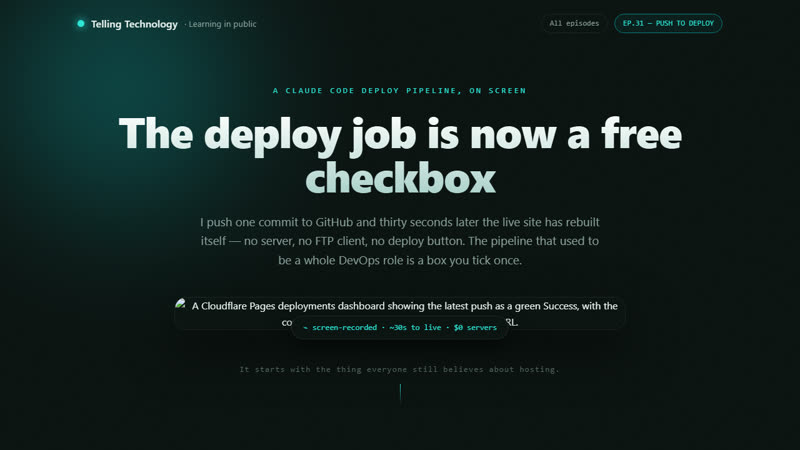
The deploy job is now a free checkbox
I push one commit to GitHub and thirty seconds later Cloudflare Pages has rebuilt and redeployed the live site — no server, no FTP, no deploy button. The pipeline that used to be a whole DevOps role is a box you tick once.
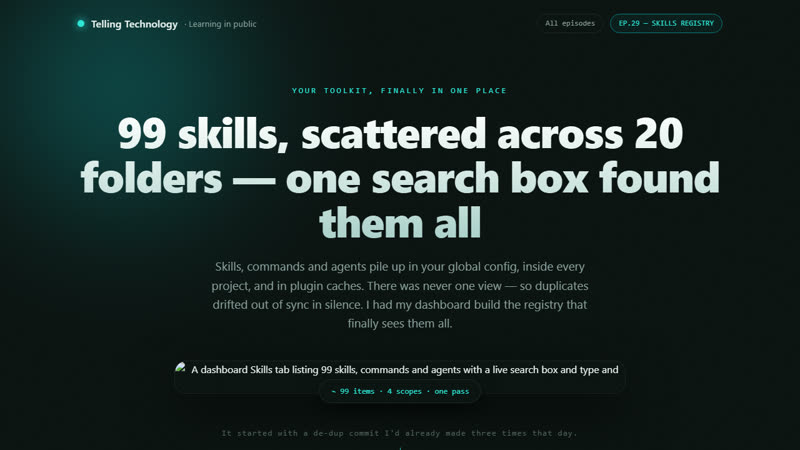
99 skills, scattered across 20 folders — one search box found them all
Skills, commands and agents pile up in your global config, inside every project, and in plugin caches — no single view, and duplicates drift out of sync in silence. I had my dashboard build a registry that walks every location, catalogs all 99, and surfaces the strays in one search box.
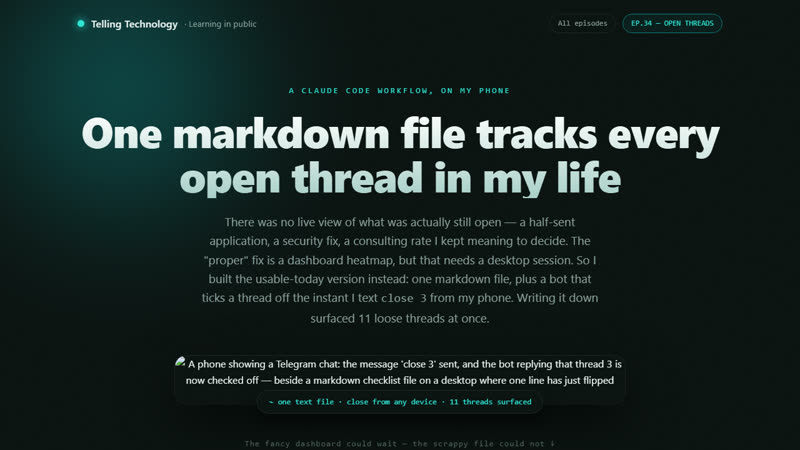
One markdown file tracks every open thread in my life — closeable from my phone
The proper fix for tracking loose ends is a dashboard heatmap (todo #34) — but that needs a desktop session. So I built the usable-today version first: inbox/open-threads.md, one line per open thread, closed by texting 'close 3' from any device. Writing it down became a free audit — 11 loose threads surfaced the moment it existed, two I'd have sworn were done. The scrappy text file that beat the fancy dashboard. Channel A, on camera.
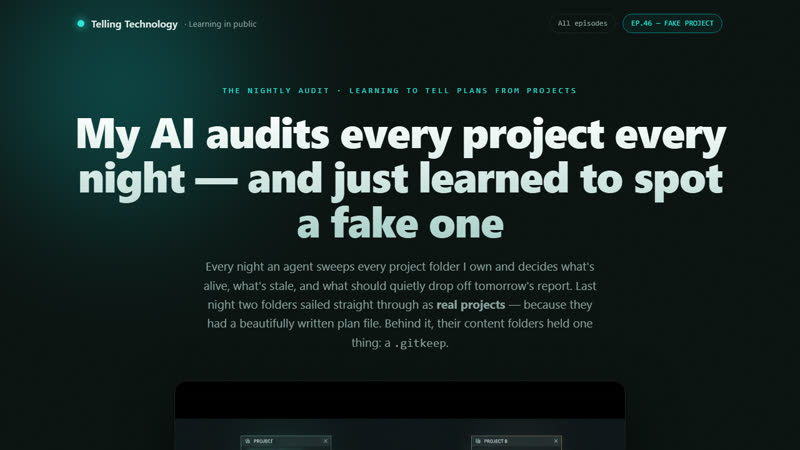
My AI audits every project every night — and just learned to spot a fake one
A master-architect agent sweeps every project folder in the workspace each night to decide what's alive and what's stale. Two folders with perfectly written plan files passed as real work while their content folders held nothing but a .gitkeep — so the discovery filter learned to look inside.
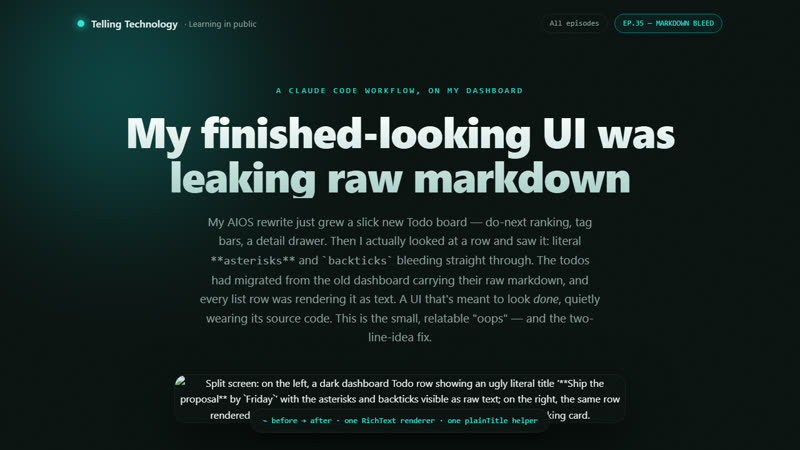
My finished-looking dashboard was leaking raw markdown
My AIOS rewrite grew a slick new Todo board — then every row was leaking raw **markdown**: literal asterisks and backticks in a UI that's supposed to look done. The fix: a RichText renderer for the drawer, a plainTitle helper that strips markdown from every row title.
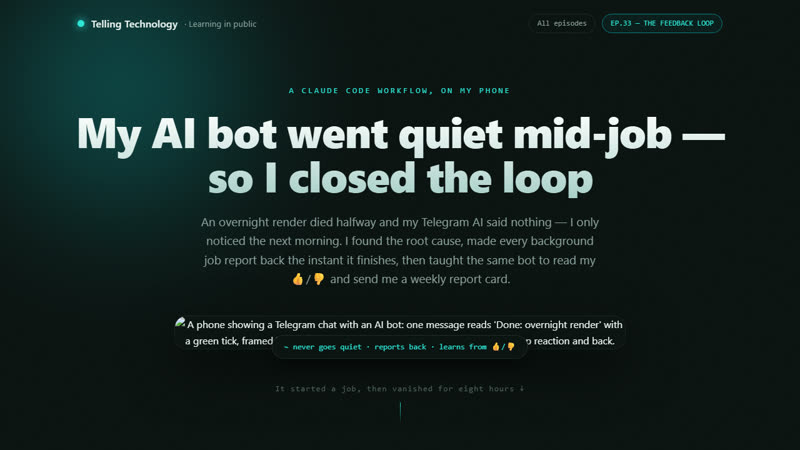
My AI bot went quiet mid-job — so I closed the loop
An overnight render died halfway and my Telegram AI said nothing — a per-message claude -p process exits after replying, so anything it backgrounds dies untracked. I built run-detached-notify.ps1 (one guaranteed Done/FAILED message on finish), then taught the same bot to read my 👍/👎 and mail a weekly report card (weekly-feedback-digest.ps1). The AI's feedback loop, closed: it reports back and it listens back. Channel A, on camera.
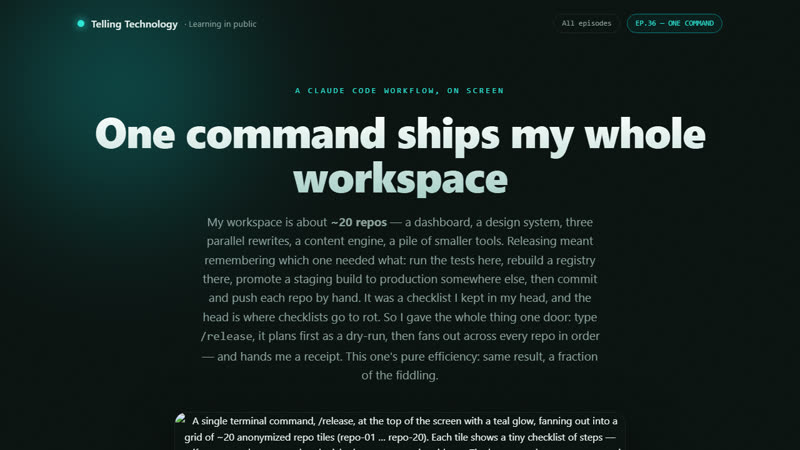
One command ships my whole AI workspace
One push to GitHub, and /release fans out lint, test, commit, push and deploy across roughly 20 repos — the DevOps job that used to be a manual per-repo chore is a single command now.
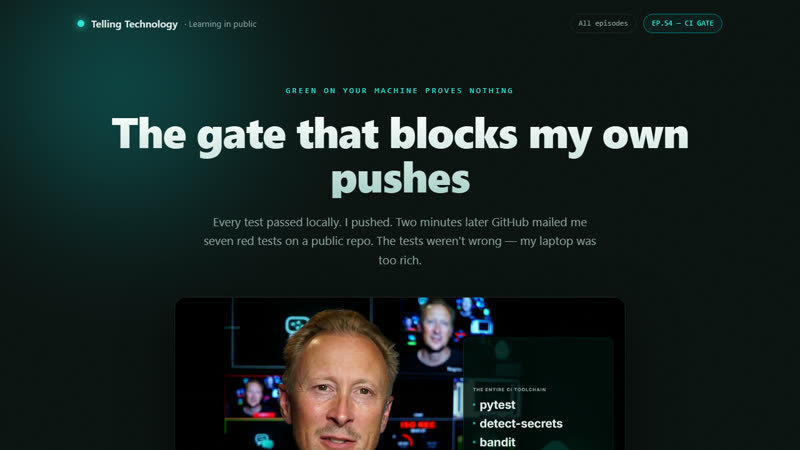
The gate that blocks my own pushes
All the tests passed, I pushed, and two minutes later GitHub mailed a Run failed notice with seven red tests on a public repo. The tests weren't wrong - this laptop is too rich. It has every library and API key I've ever installed, while the CI runner installs exactly three things: pytest, detect-secrets, bandit. So two test files quietly leaned on what only exists here and died on a clean machine. Which makes the obvious fix useless: running them again locally reproduces the same blind spot, because green on my machine is not evidence of anything. The gate is a pre-push hook that runs a throwaway environment holding exactly what the runner holds - same three checks, same order - and if any fail the push never leaves the laptop. Two details make or break it: the hook is pinned to Unix line endings (one stray carriage return and it stops running silently, which is worse than no gate at all) and it's committed as executable, or git just skips it.
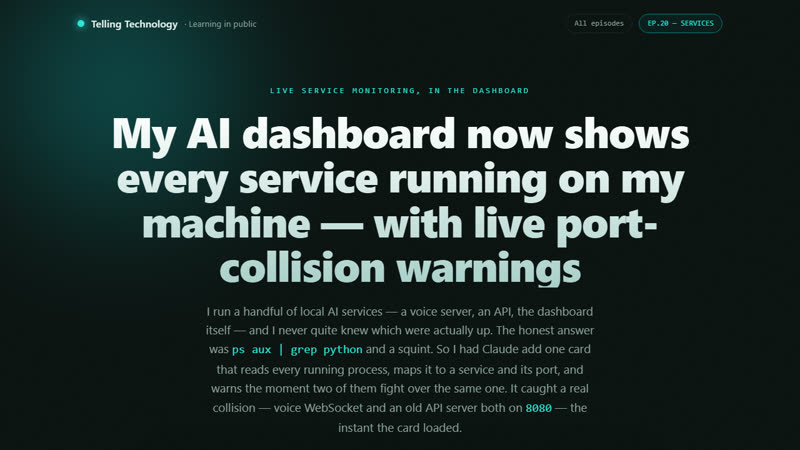
My AI dashboard now shows every service running on my machine — with live port-collision warnings
One card reads every running process, maps it to a service and a port, and flags collisions. It caught two services fighting over port 8080 the instant it loaded.
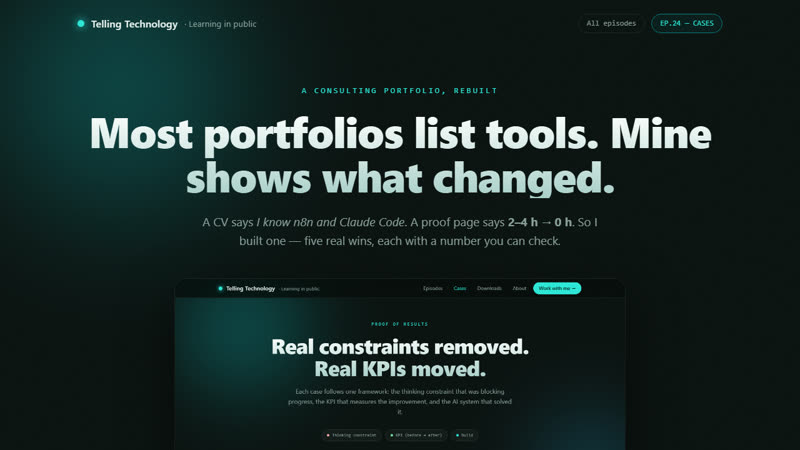
The proof page — what changed, not what I built
Most portfolios list tools. I built a proof page that shows the delta. Five real wins, each one the same shape: the thinking constraint that was blocking me, the KPI before and after, and the AI system that moved it — 2-4 h to 0 h, 20 min to 3 min, scraping to one command, silent context deaths to zero. Every number links to the episode that proves it. The story of building showcase/cases.html.
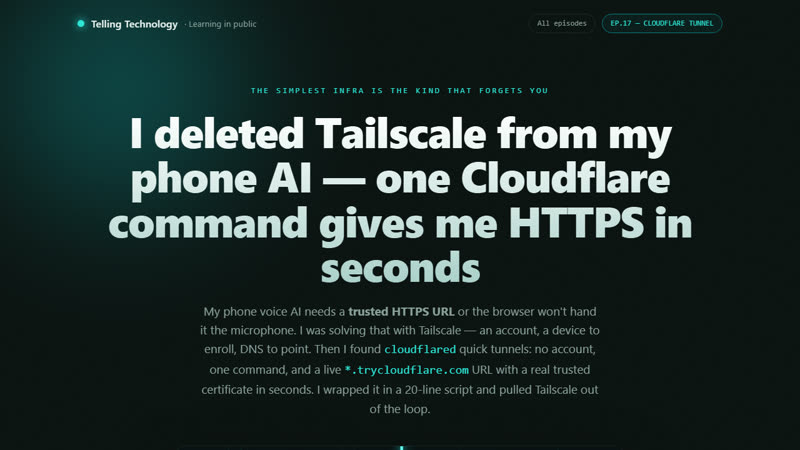
One Cloudflare command = HTTPS in seconds
My phone voice AI needed a trusted HTTPS URL. I was using Tailscale — account, device enrollment, DNS. Then I found cloudflared quick tunnels: zero account, one command, a live URL with a real cert in seconds. Wrapped it in run-tunnel.ps1 and ripped Tailscale out.
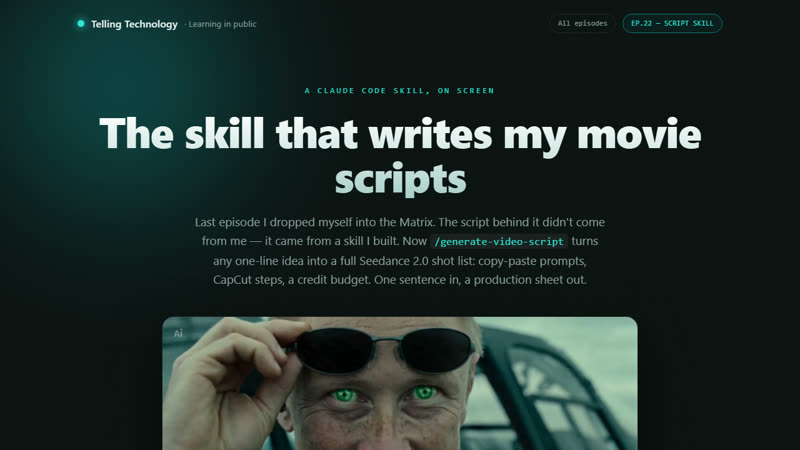
The skill that writes my movie scripts
One sentence in, a full Seedance 2.0 shot list out. I built a Claude Code skill that writes the script for any AI-video idea — copy-paste prompts, CapCut steps, a credit budget. Here's the anatomy.
My AI dashboard reads every conversation I've ever had — and resumes them from the browser
I built a dashboard button that opens any past Claude Code session in the browser, shows the full parsed conversation — tool calls and all — then resumes it in the terminal with one click.
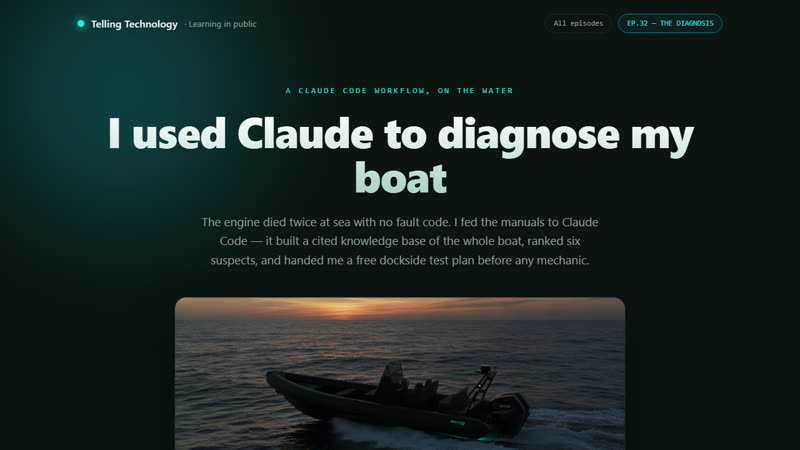
I used Claude to diagnose my boat
My outboard died twice at sea with no fault code and restarted instantly. I fed the real manuals to Claude Code — it built a cited knowledge base of the whole boat, ranked six suspects (kill-switch stop-circuit #1), and handed me a free dockside test plan before any mechanic. Off-brand domain, on-brand method: AI debugs a real-world problem from the manuals up. Channel A, on camera.
My AI shops for the cheapest brain for the job
Running AI at home burns real money. So I had Claude build a two-layer router: one flag picks the cheapest model that's still good enough, then the cheapest host to serve it. Same prompts, same results, a fraction of the bill.
20 agents audit my machine while I sleep
One cron job at 01:00 fans out 20 AI agents that audit every repo on my machine for health and security, then write a single ranked morning report — done before I pour the coffee.
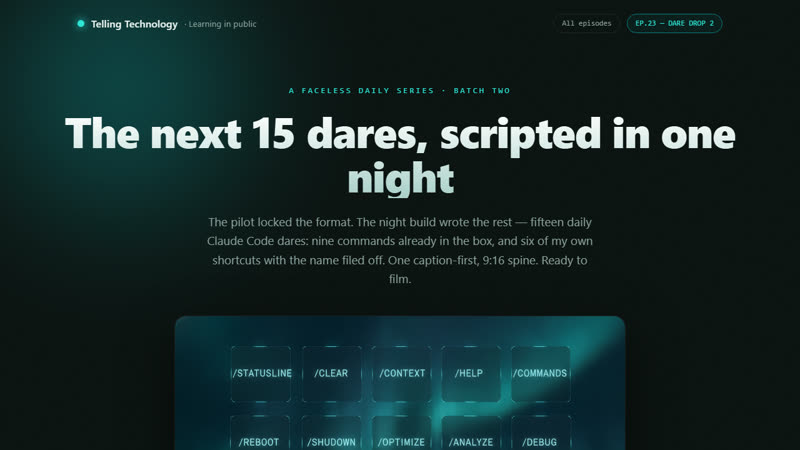
The next 15 dares, scripted in one night
Fifteen daily Claude Code dares scripted in one night build — 9 built-in commands + 6 anonymized power-user shortcuts, one caption-first 9:16 spine.
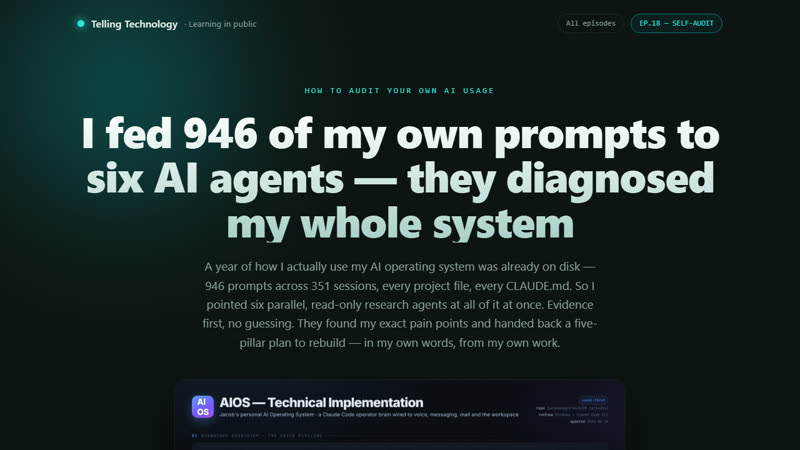
I fed 946 of my prompts to six AI agents
Six parallel read-only Claude agents read 946 of my own prompts across 351 sessions, found my exact pain points, and handed me a five-pillar redesign. Here's the method, so you can audit your own AI usage.
Why my Telegram AI beats the official Claude app
Everyone opens the polished Claude app and desktop. I mostly use a Telegram bot and a bare terminal instead — same AI brain, but they sit next to my real files, inbox and scripts, so they can actually DO things. Page tag EP.11; built by the night build.
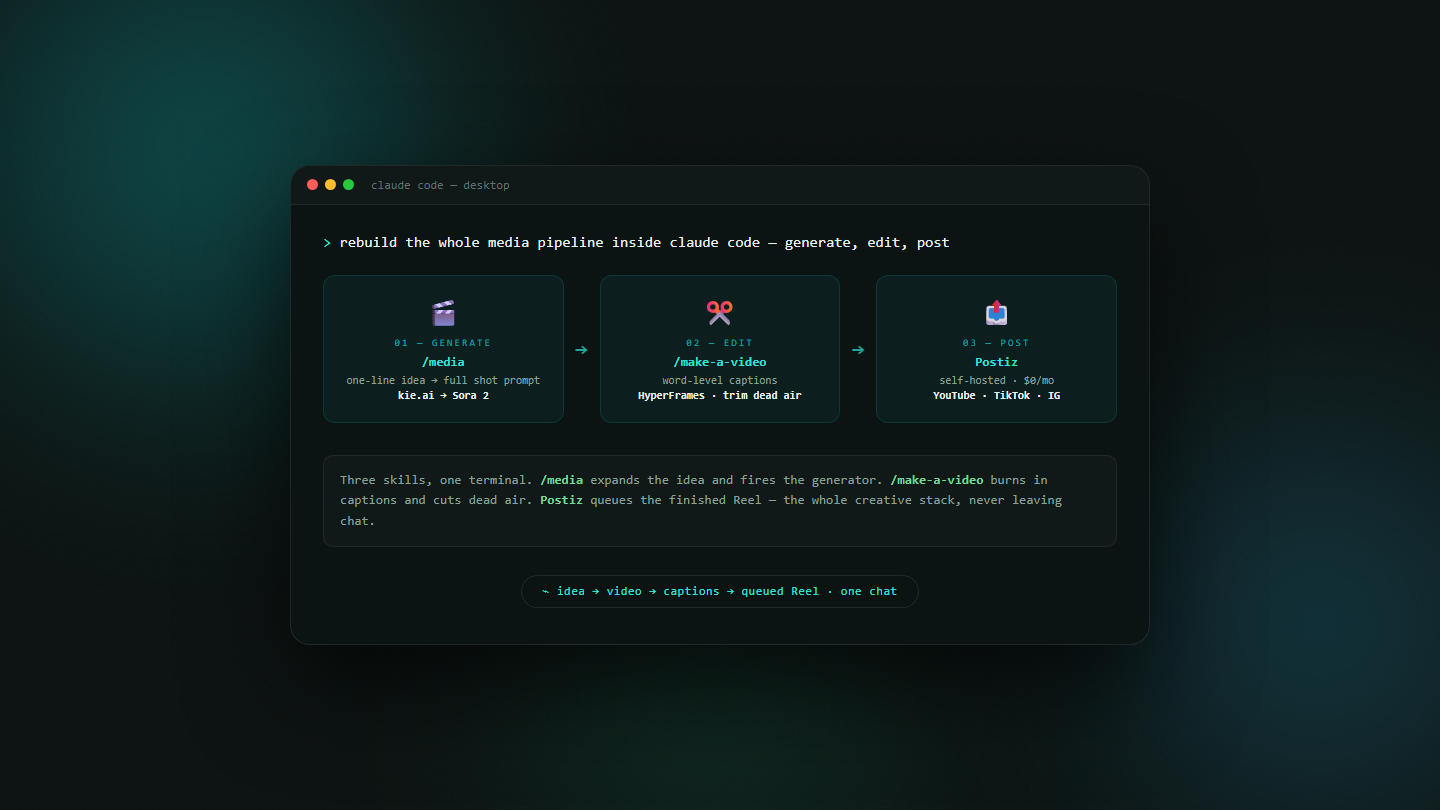
An AI media factory inside Claude Code
The popular media-agent stack lives in a wall of n8n nodes plus a paid poster. I rebuilt the whole thing inside Claude Code: type an idea in chat and it expands the prompt, generates the video, captions and trims it, and queues the finished Reel. Make, edit, post — one terminal.
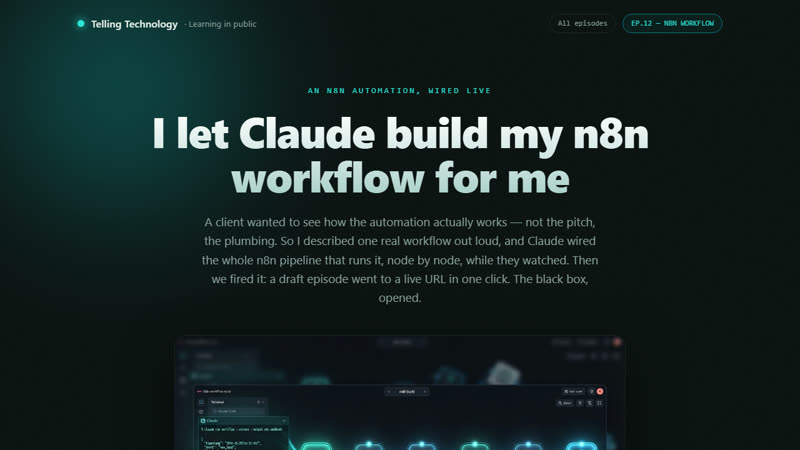
I let Claude build my n8n workflow — live
A client wanted to see how the automation actually works. So I described one real workflow out loud and Claude wired the whole n8n pipeline node by node, then fired it: draft episode to live URL in one click.
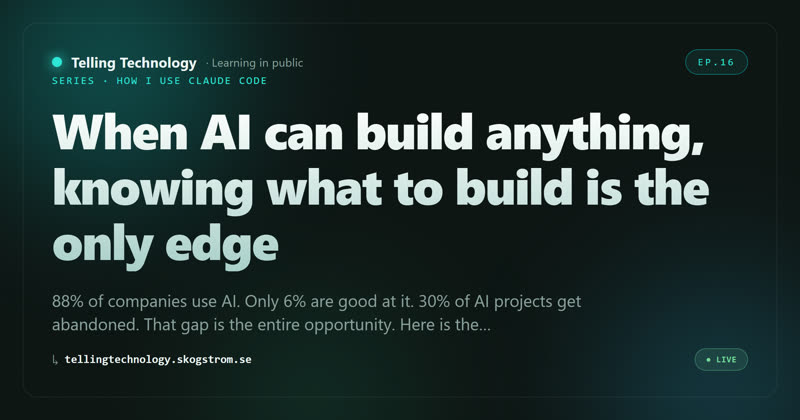
When AI can build anything, knowing what to build is the only edge
88% of companies use AI. Only 6% are good at it. 30% of AI projects get abandoned. That gap is the entire opportunity. Here is the consulting pitch, the doctor-vs-pharmacist positioning, the Constraint→KPI→Build method, and the 60-second Matrix-operator video script.
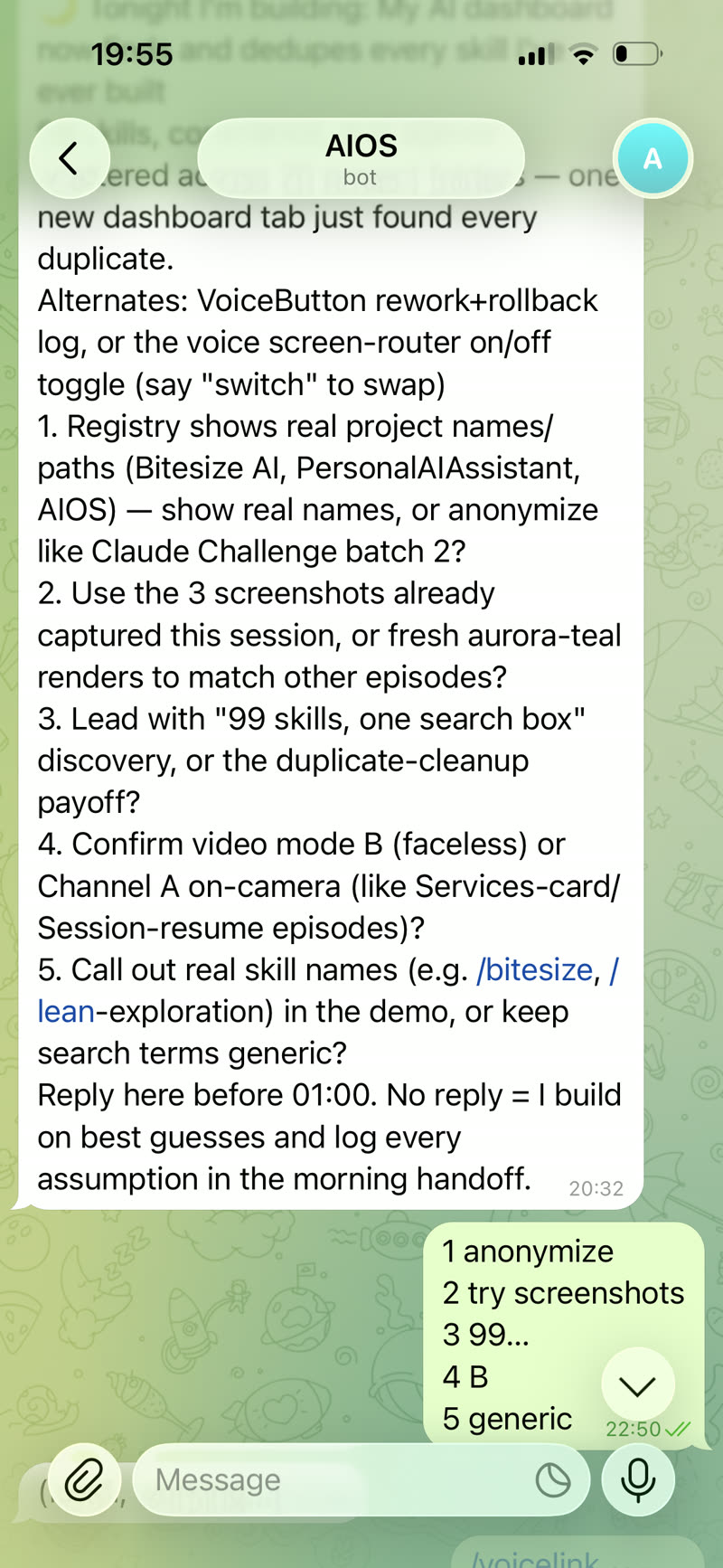
A voice AI on my phone that knows my whole life
Siri can't reach my files and the Claude app has no desktop voice. So I built a push-to-talk PWA that installs to my phone's home screen, routes each question across two AI tiers, talks back out loud, and already knows every project I'm running.

I mine my Claude Code chat history for episodes
The sharpest ideas happen mid-session and vanish when you close the tab. I taught an AI to read my saved sessions back, score each chunk for novelty and surprise, and hand me a pre-qualified backlog — each idea carrying its own source transcript.
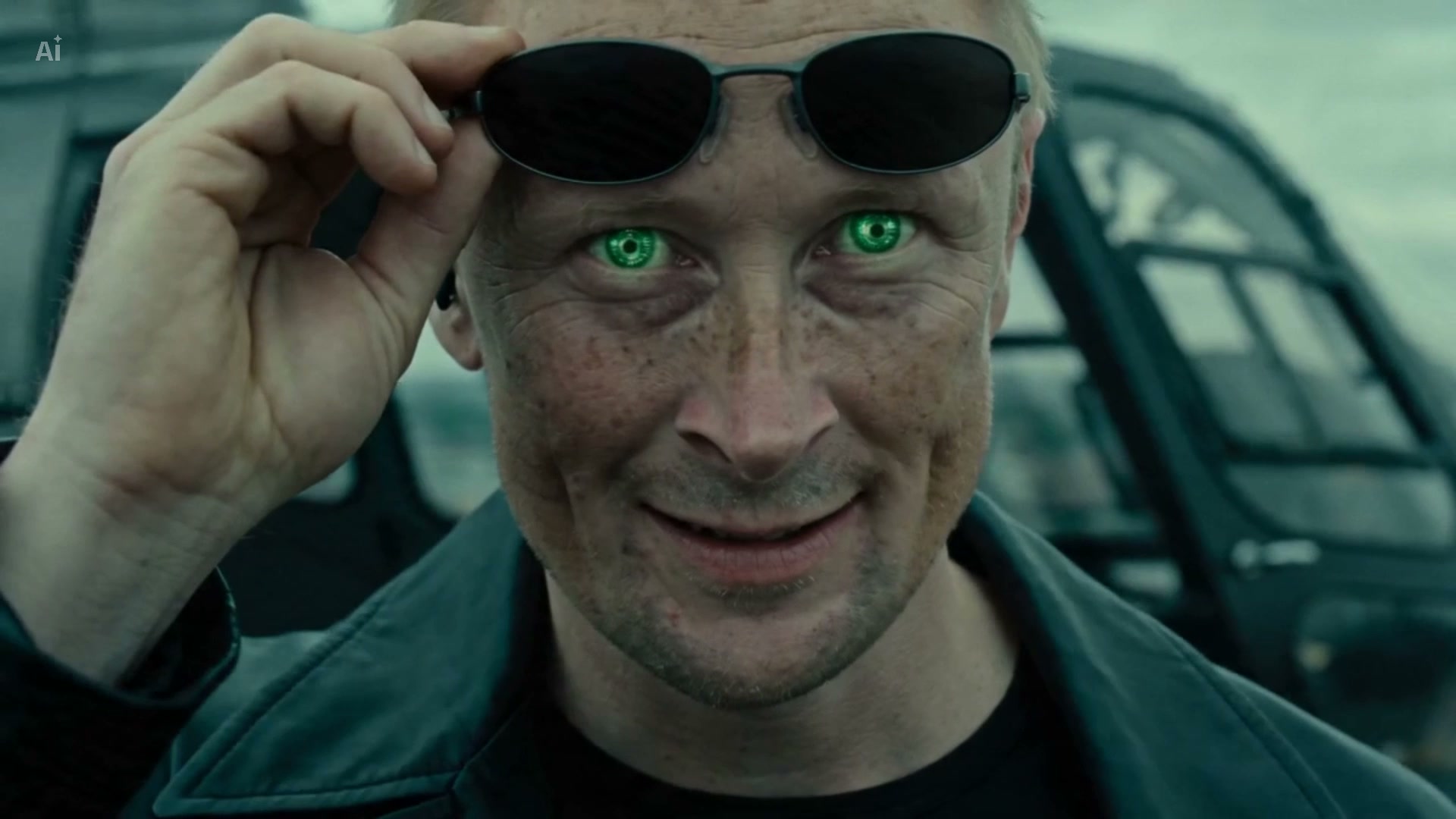
Now a computer geek can make movies
I'm not a filmmaker. But I built a skill that gave Claude the script, Seedance 2.0 the shots, and CapCut the edit — 18 seconds, two generations, zero camera. The 6-frame gallery shows the exact prompt behind each shot.
Today's Claude Challenge — dare to accept?
A faceless daily series: one small Claude Code move a day. 21 dares in two tiers — built-in commands and skills I built myself — each one you can try in five minutes.
My AI makes, edits, and posts my videos — I just type the idea
The n8n media agent plus paid poster, rebuilt inside Claude Code. Type a topic: it expands the prompt, fires kie.ai → Sora 2, burns in captions, trims dead air, and queues the Reel in self-hosted Postiz. $0/mo on the posting.
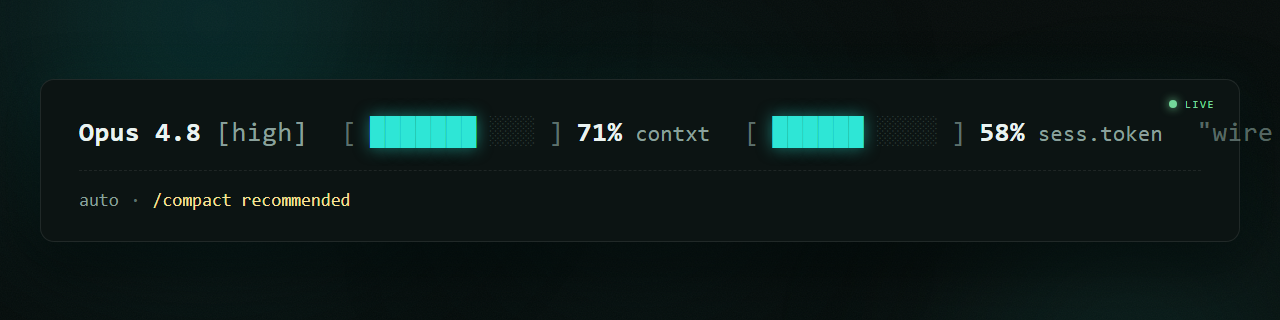
My terminal now shows how much brain my AI has left
Long sessions die silently as context fills. I had the AI build its own cockpit status line — model, effort, and two live fuel bars — so I know exactly when to /compact.
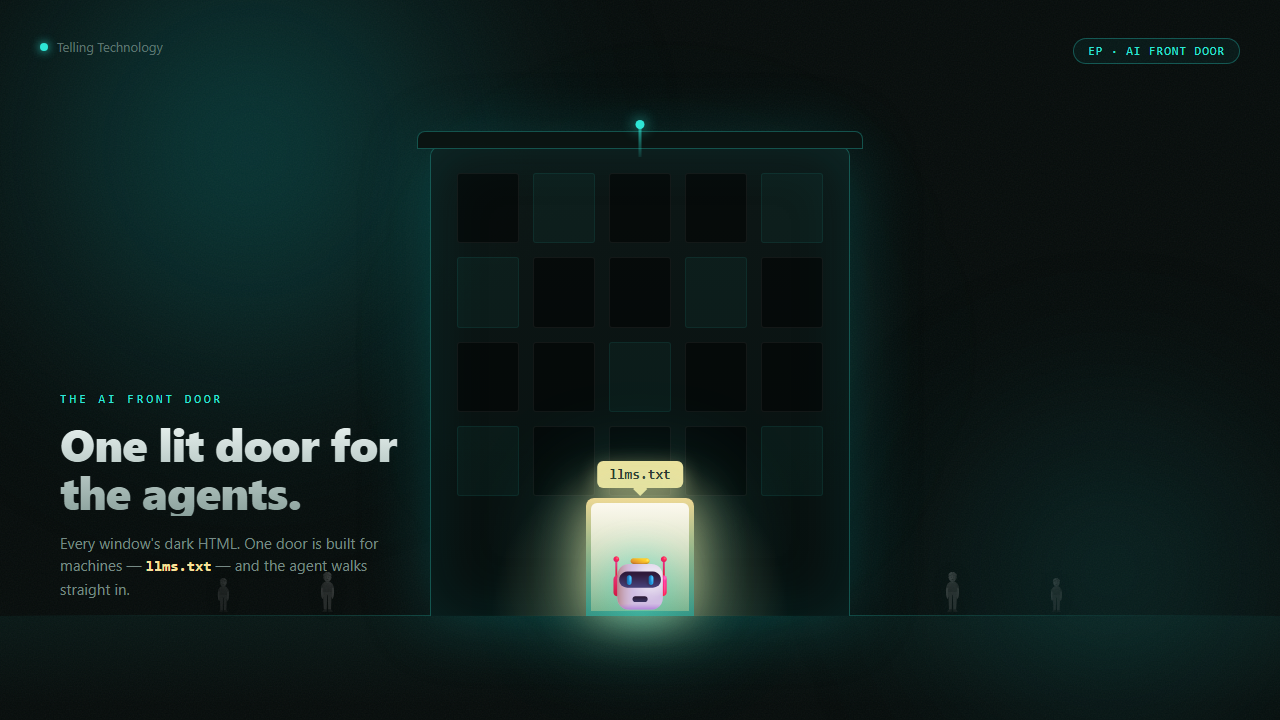
I built my website a front door for AI
Agents scrape a site built for human eyes badly. So I gave mine an llms.txt, a JSON index, a tiny CLI and an MCP server — now any Claude reads the whole site from one command.
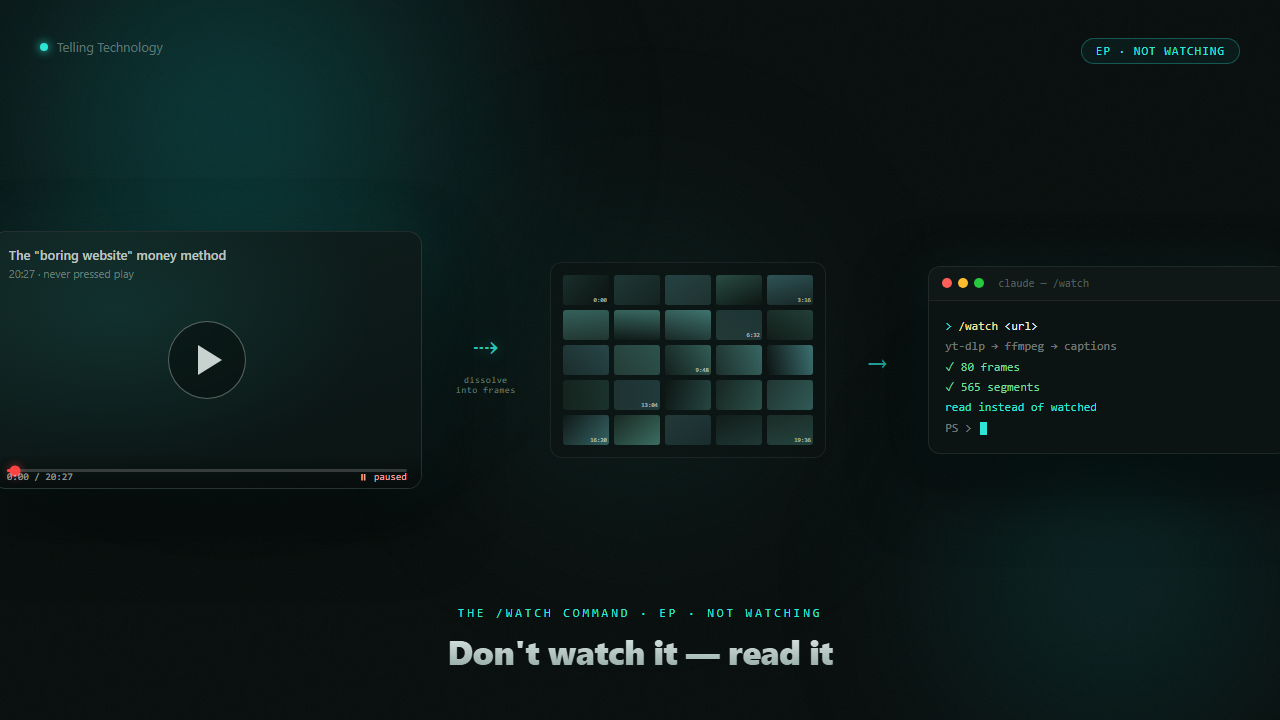
Learn things by not watching
A 20-minute tutorial I never played: one slash command cut it into 80 frames, read 565 transcript segments — then three research agents proved its money claims were ~4× inflated.
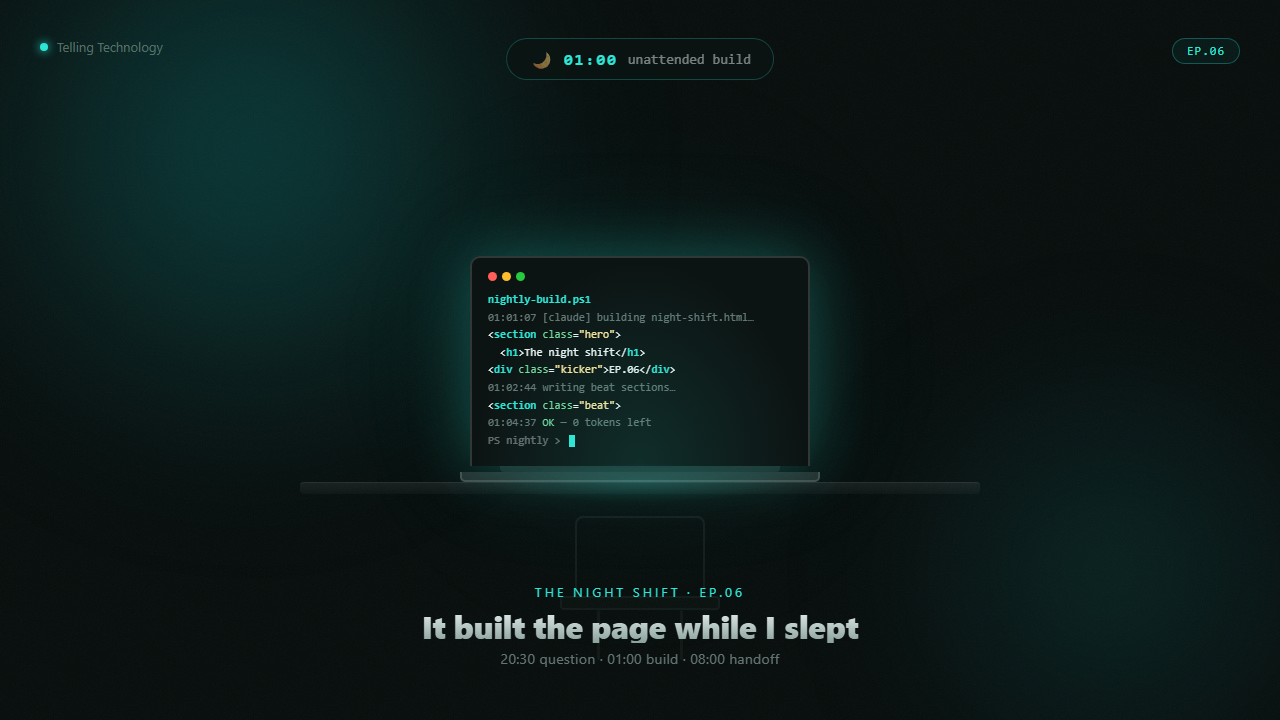
I slept. A fresh AI built the next episode without me.
Half past eight I gave it the idea; it asked six questions. I answered two from the couch and fell asleep. By one in the morning it had read the brief and built this whole page alone — then left a note listing every guess it made.
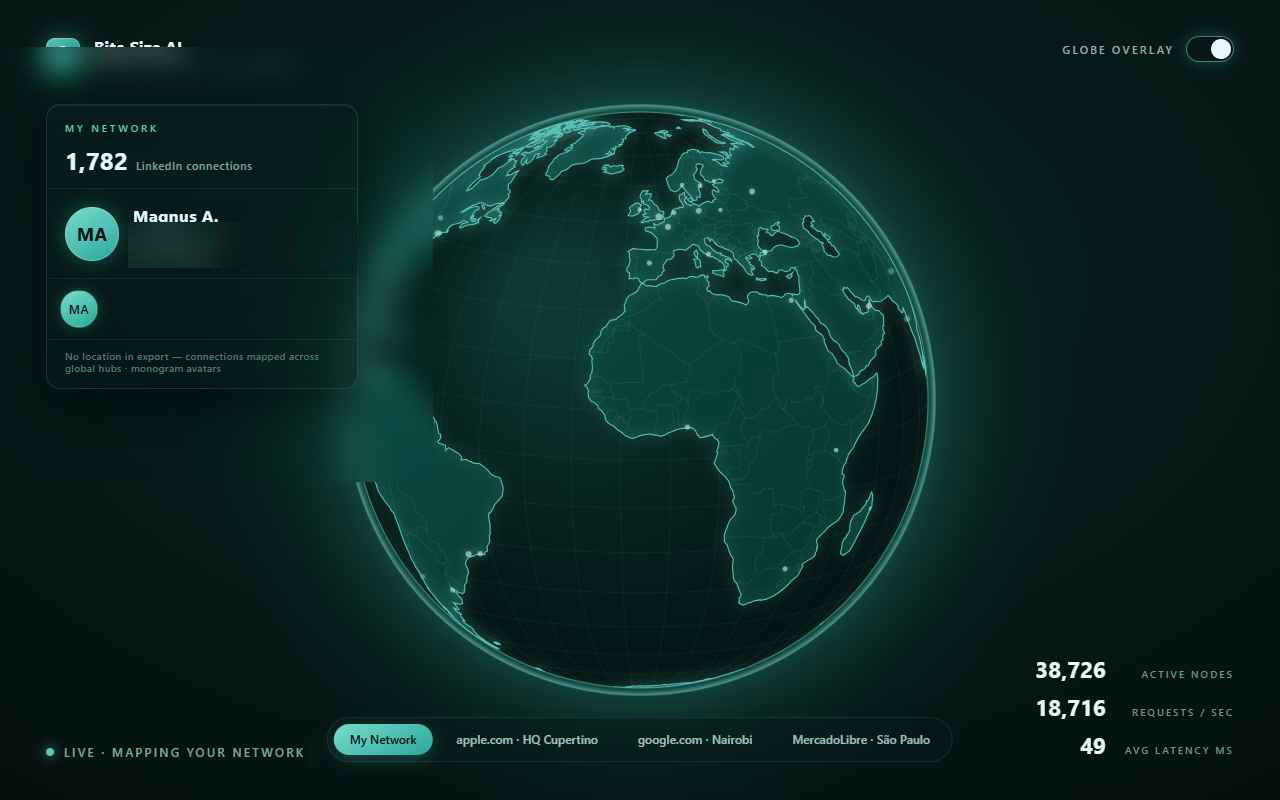
I put my whole network on the planet
The AI-built globe got personal: 1,782 LinkedIn contacts stream onto it as a living layer — thin pins, a terminal at 50 names/sec, and three real packet-trace routes. One toggle fades it all back to the plain globe.
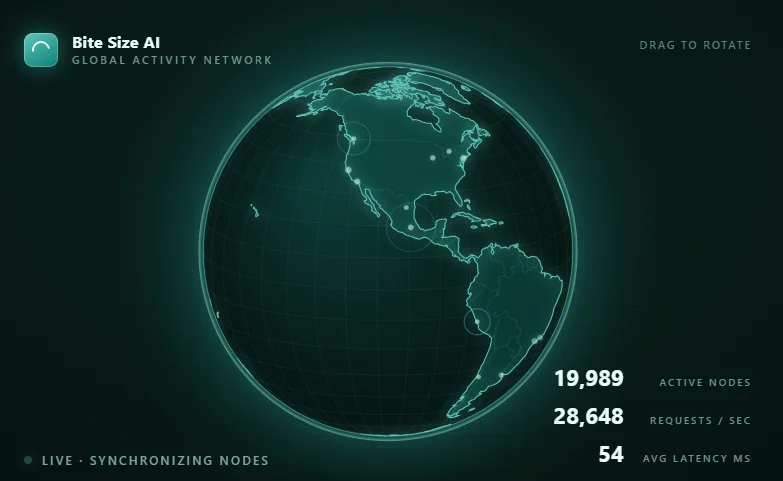
I gave an AI one sentence — it built a planet
A rotating, futuristic Earth for the brand, designed in one chat on claude.ai/design. Every prompt, the palette it guessed from a screenshot, and a live globe you can drag to spin.
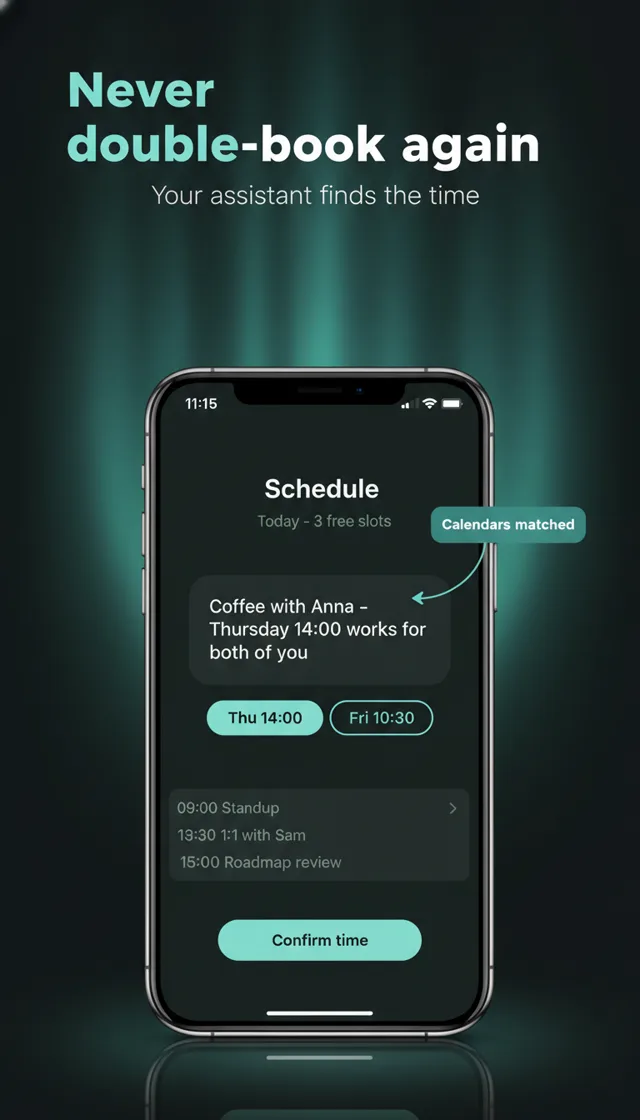
I ditched the borrowed pencil style — my AI designs app-store screens now
Five art directions fought a style-off over the same screen. The winner became the house style — and sixteen screens later, the look is mine.
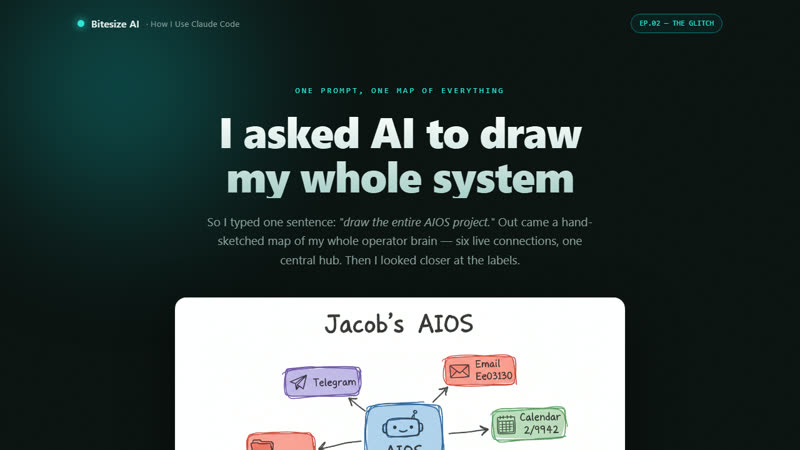
I asked AI to draw my whole system — it leaked secret codes
One prompt mapped my entire AI OS as a sketch — and the model quietly leaked raw colour codes into the labels. The glitch, and the 5-cent fix.
I taught Claude Code to draw like a human
One skill turns a plain prompt into a hand-sketched diagram — no design tool, ~5 cents a render.
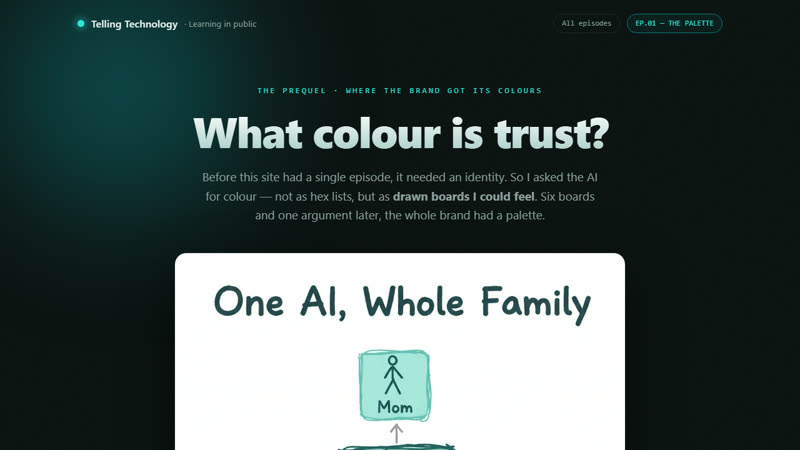
What colour is trust? I asked an AI — it overruled my pick
Six drawn candidate boards in two rounds, a winner called Calm Lagoon — and the moment the AI rejected my favourite shade for accessibility.